Read the gathering as an opening chapter
A public square offers a striking picture of a city: people arriving from different directions, small conversations beside a larger crowd, a camera searching for an angle. The scene makes collective life visible. What takes more attention is the purpose behind the meeting, the relationships that brought people there and what happens once the square becomes quiet again.
This guide follows that longer story. It is about understanding community movements and public gatherings in Toronto, from an informal neighbourhood conversation to a structured opportunity to comment on a City project. It offers ways to find context and take part thoughtfully. It does not report a newly announced event or speak on behalf of an organiser.
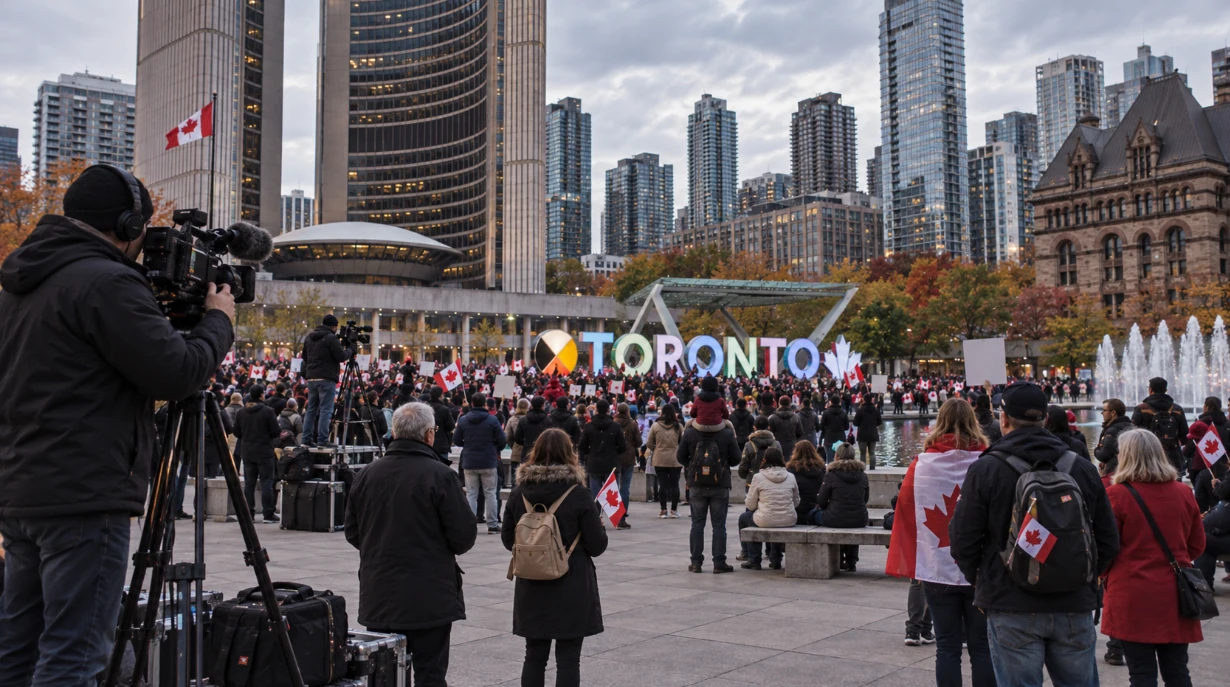
The supplied visuals introduce a public-square setting. They are editorial illustrations, and we have no verified event details attached to them. A flag, a crowd or a familiar building does not establish a shared demand, an organisation or a date. The distinction matters because useful community reporting begins with information that can be checked.
A square is a setting with many possible uses
Nathan Phillips Square, outside Toronto City Hall, is a public gathering place that hosts community and City-led events. The City’s square guide provides an introduction to the place and links to its features, bookings and schedule. That geographic context helps explain why a square can appear in very different kinds of public stories.
A cultural celebration, a gathering around a shared concern and a casual meeting can all involve people occupying a common space. They are not interchangeable. Before describing a scene, ask what reliable information identifies its purpose. If you are thinking of attending something, look for a notice from the organiser that gives the format and current details.
The City’s Nathan Phillips Square event schedule links to organisers for further information. It is one place to check, rather than a complete explanation of everything that might occur in the square. A listing does not tell you what every participant thinks. An absent listing, by itself, does not establish that an independently described gathering did not happen.
Follow the relationship between a moment and a movement
In this publication, a community movement means people working over time around a shared concern or idea. A gathering may be part of that work, but one busy afternoon does not tell its whole history. Look for the activities before and after it: a conversation among neighbours, a published explanation of a concern, a meeting where responsibilities are discussed, or a later account of what was learned.
Ask who is speaking and in what capacity. Someone describing a personal experience is not necessarily speaking for everyone nearby. A named group’s statement should be attributed to that group. A reported intention should not become an achieved result simply because it appears beside a photograph of a crowd.
There is also room for disagreement within a community. An attentive account can show the question being discussed without announcing that an entire neighbourhood has one view. Readers benefit from knowing where an idea is clear, where the evidence is incomplete and whose perspective has yet to be heard.
Look beyond the most visible meeting place
Community life also develops through smaller, repeated activities. The City’s Community Initiatives resources cover resident-led work it helps facilitate, while its Community Development Officers directory connects readers with information about support for neighbourhood planning and community work. These resources are starting points for finding relevant local contacts, not promises that a particular idea has official backing.
For an example of a practical setting, Together in Parks describes ways residents can propose activities such as clean-ups, recreation, arts and stewardship. Requirements depend on the activity, and some uses need approvals. Check the current process directly before presenting an idea as a confirmed event.
Illustrative example: neighbours interested in a shared outdoor space might begin by comparing the concerns they have noticed, then identify the appropriate contact and read the requirements for a possible activity. At this stage, they have a question to explore. They do not yet have an approved event, a confirmed venue or permission to speak for the neighbourhood.
Use the route that matches the question
A community conversation and a formal City consultation serve different purposes. The Have Your Say Toronto platform lists public engagement projects at different stages. On a relevant project page, check the topic, location, methods for input and whether an opportunity is open or concluded. Participation contributes information to a process; it does not by itself announce a final decision.
For an issue on a Council or committee agenda, the City provides a separate route. Its Council and committee participation instructions explain written comments and requests to speak at a committee or board on a specific item. Full Council does not generally hear public presenters, apart from legislated requirements. Read the current instructions and the agenda item rather than assuming every meeting offers the same speaking format.
The same guidance explains that written and spoken comments become part of a public record. Before sending information directly to the City, review that notice and decide what is relevant to the item. Watching a meeting, reading an agenda or following a project update can also be a useful first step when you are still learning the issue.
Bring curiosity to the conversation
Prepare one question you would like to understand, then leave space for an answer that is more complicated than expected. Ask how a concern affects everyday life, what has already been tried and what information is still missing. Distinguish a personal observation from a claim about the whole city.
Participation does not require an instant commitment. You can listen before deciding whether to become involved. If a role interests you, ask what it involves, how much time it needs and whom to contact for the current details. The City’s Get Involved directory offers several public participation routes without suggesting that all independent community activity is a City programme.
Give the next chapter a manageable shape
After a gathering, make three short notes: what you learned, what you still need to verify and one possible follow-up. That follow-up could be reading a project page, asking the organiser a specific question or checking the next opportunity for a local activity. A useful next step is one you understand and have time to complete.
Our link to Toronto Public Library’s event directory offers another way to explore smaller conversations, talks and community-related programmes. Check each listing for its location, audience, format and any registration requirements. Our participation chapter helps you choose an approach, and the Before you go checklist turns your preparation into twelve practical prompts.
Questions worth keeping separate
Does every gathering represent a movement?
No. A gathering can have many purposes. Use a verified description from the people organising it, and avoid assigning a cause or collective position to everyone shown in a picture.
Can I book a place at an event here?
This publication does not organise gatherings or accept registrations. Follow the original organiser’s notice for attendance details. The checklist is for your own preparation.
Where can I check a City consultation?
Start with Have Your Say Toronto, then read the relevant project page. Check its stage, scope and current participation instructions before acting.
Go to the original sources
Source review: 11 October 2026. Follow the original pages for current listings, participation instructions and project updates. A source link does not establish an affiliation.
- City of Toronto — Nathan Phillips Square
- City of Toronto — Events Happening at Nathan Phillips Square
- City of Toronto — Community Initiatives
- City of Toronto — Community Development Officers
- City of Toronto — Together in Parks
- Have Your Say Toronto — public engagement projects
- City of Toronto — Have Your Say at Council & Committee Meetings
- City of Toronto — Get Involved
- Toronto Public Library — Events